The umbrella starts out in black and white. As the rain starts falling on the umbrella, each drop will cause the colorful design to show through. Eventually when the whole umbrella is wet it will have morphed into the vibrant colorful version that you can see above. When the rain stops and the umbrella dries the colorful design will slowly fade back to white.They don't seem to be the only ones, since you can also get a Suck UK Color Changing Umbrella So let us start the color changing wars--maybe even start a color changing blog, so you can track color changing animals and color changing roof tiles. Or, reject it all and accept the true umbrella color: black.
Tuesday, February 23, 2010
Squidarella: The Color Changing Umbrella
http://www.urbantrim.com/squidarella-color-changing-umbrella/Thanks to Fabsugar for directing us to this one. The designers at SquidLondon have come up with this color changing technology. According to UrbanTrim:

Friday, February 19, 2010
X-Ray Umbrellas: Disappointing, You Can't See Through Things

Spada's project was inspired by the magazine ReadyMade
 . She was given the task of finding objects that are commonly discarded, and re-purposing them in a way similar to projects found in the magazine.
Wednesday, February 17, 2010
Winter Weather: Snow and Umbrellas: Yea or Nay?


Well, apparently he isn't the only ponderor this season. The Washington Post Capital Weather Gang poll, with a tip of the hat to the Urban Bohemian, had 3% always using them, 23% sometimes, and 72% "Never. Umbrellas in snow are wimpy."
But, go further in the blogossphere and the Net, and you will find paintings of umbrellas in the snow, Japanese snow umbrellas, and comments that some snowy places (Slovenia) have always used umbrellas.
So, folks, if it keeps the snow off your head and keeps you dry, use that umbrella.
Sunday, February 14, 2010
Miss Umbrella Girl: Does This Have To Be Only for Malaysians?
) Now we know where to go to find folks who truly appreciate umbrellas for what they are good for--not rain, nor sun, but advertising! According to the The Star--Malaysia's biggest English newspaper, new Miss Umbrella Girl 2010 contest, to be held in Penang from March 13-14, hopes to produce a new batch of brolly beauties who are articulate and media savvy.
What are "umbrella girls"? Apparently, they "are an integral part of glamour sports events like the MotoGP, SuperBike Championship, Formula One, Nascar and other team races. Sponsors hire them to hold umbrellas over the heads of their riders while wearing their logos and corporate colours. They are indispensable at high profile races and part of their job is to pose with admirers and spectators."
 Unfortunately, however, they "are ranked lower than models, actresses and beauty queens." But at least they are UMBRELLA GIRLS
 . In other countries, they go by other names: are called Race Queens (Japan), Pit Babes
 (Britain), Pit Girls or Grid Girls
 (Europe), Racing Girls (Korea), and Pretties (Thailand).
So, if you want to be an Umbrella Girl (or a Mini Umbrella Girl), head to the island of Penang (and register at Go Penang). [You could also become the Most Popular Umbrella Girl or the Most Talented Umbrella Girl (although I doubt that is judged by how well you hold the umbrella).]

What are "umbrella girls"? Apparently, they "are an integral part of glamour sports events like the MotoGP, SuperBike Championship, Formula One, Nascar and other team races. Sponsors hire them to hold umbrellas over the heads of their riders while wearing their logos and corporate colours. They are indispensable at high profile races and part of their job is to pose with admirers and spectators."
 . In other countries, they go by other names: are called Race Queens (Japan), Pit Babes (Britain), Pit Girls or Grid Girls (Europe), Racing Girls (Korea), and Pretties (Thailand).
So, if you want to be an Umbrella Girl (or a Mini Umbrella Girl), head to the island of Penang (and register at Go Penang). [You could also become the Most Popular Umbrella Girl or the Most Talented Umbrella Girl (although I doubt that is judged by how well you hold the umbrella).]
Thursday, February 11, 2010
Papparazi on the Prowl: Umbrella Protects Suri Cruise from Snow

 one, which she proudly showed off to the doorman."
So, what was her other choice? Maybe she still has her Lady Bug umbrella (thank you again,Daily Mail) from 2008?
Tuesday, February 9, 2010
Review: Wired Touts Heavy Duty Umbrella: A "Blunt" Instrument

Other features that kept the reviewer dry in San Francisco include "a solid plastic collar that you push up until the umbrella snaps into shape" and "the ribs' tips are rounded, which keeps them from poking through the fabric."
But why trust the reviewer, check them out yourself at Blunt umbrellas or watch it in action:
Monday, February 8, 2010
Brollies Lost and Brollies Sold: We Need Our Umbrellas
 Today's news from the world of umbrellas has a sad tale from Australia and an economic tale from Pakistan. First, the sad story. According to Cambelltown's Macarthur Chronicle, an Barbara Fulton, from Airds, is hoping an umbrella with sentimental value she lost can be handed back.
 She lost the blue umbrella with black polka dots on Saturday, January 30 after she accidentally left it on a fence near the Dumaresq St bus stop. The umbrella was a gift from her daughter, who died of cancer several years ago. Lost Umbrellas
 are always sad, but we do send our wishes to Barbara.
Further establishing the need for our umbrellas is this story from the Daily Times of Islamabad, which is quoted in its entirely:
With the start of recent rains, a new variety of umbrellas in main and small markets of Rawalpindi and Islamabad has emerged and their sale has witnessed an increase. This news agency observed that the rain forced people to buy the umbrellas for carrying out their routine activities, but the vendors and shopkeepers were taking advantage of the situation and demanding high prices. Talking to this agency, Haq Nawaz, a commuter, termed umbrella an essential item to go out of the home during rain.

Sunday, February 7, 2010
So What's Wrong with Being an Umbrella Stand? Who Cares if it Is Worth a Fortune!

 made during the reign of Emperor Qianlong
 and . . . shame of shame . . . had been using it to store old umbrellas in a back room! For those who treasure umbrellas, what better way to store them than in a vase worth £500,000. And, to add to the criticism of umbrella stands, the stories suggest that the vase could have been worth twice as much if not damaged--presumably by the lowly umbrellas placed in said vase.
And, in a case of life imitating art, the Daily Mail says "The find is identical to a plot from the TV series Lovejoy
 , in which the hero spotted a similarly valuable Chinese vase being used by an old lady as an umbrella stand." In other words, while there appears to be a strong cultural taboo against the used of valuable Chinese vases as umbrella stands, people are resisting the cultural pressures--at least until they become old and someone mucks around in their houses.
Friday, February 5, 2010
"There's a Man in the Habit of Hitting Me on the Head with an Umbrella" by Fernando Sorrentino

 by Les Standiford, I found the following: "'Art cannot rescue anybody from anythng,' rings the last line of a well-known story by Gilbert Sorrentino." I was taken aback by this; having read Sorrentino's Mulligan Stew: A Novel
 and some other fiction by him, I just could not believe that there was such a thing as a "well-known" story by him. So, off to the Internet. Sure enough, this quote has been picked up by at least one other source, which attributes it to The Moon in Its Flight
 , a collection of short fiction not available in my public library (but then neither is Mulligan Stew!). So maybe there is a story with the same name as this title--the "well-known" one.
Given my penchant for connecting umbrellas and literature, the next step was to search for Sorrentino and umbrellas (after a side trip to Wikipedia to read more about Sorrentino). Well, I end up with a wonderful hit, but not for Gilbert Sorrentino, but for Fernando Sorrentino
 , an Argentine writer. While not a lot of his work appears to be translated into English in published books, there are quite a few stories available on the Internet, most importantly for our purposes: "There's a Man in the Habit of Hitting Me on the Head with an Umbrella" translated by Clark M. Zlotchew. I will quote the first paragraph for you, and then you can go read the rest:
There's a man in the habit of hitting me on the head with an umbrella. It's exactly five years today that he's been hitting me on the head with his umbrella. At first I couldn't stand it; now I'm used to it.Borges, anyone?
It is available in its original Spanish, too, and was published in his collection: Imperios y servidumbres (1972)

Umbrellas as Architecture to Protect the Streets
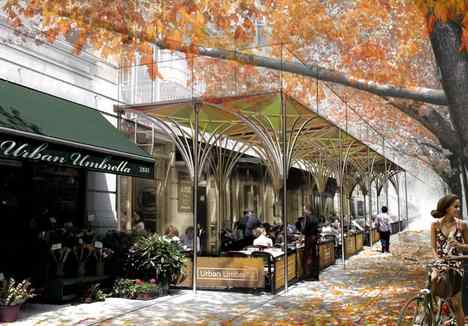 Yesterday, we were concerned that umbrellas were blocking the access to the beaches in Thailand. Today, we have the better news that we are adding umbrella-like structure to our city streets. According to the Philadelphia Inquirer, the "Urban Umbrella" is coming: Young-Hwan Choi, a University of Pennsylvania architecture student has devised an elegant new design for the sidewalk sheds that protect pedestrians during construction.
He calls the design the "Urban Umbrella," because the steel columns open up like the bones of an umbrella to support the shed roof.Go urban, umbrellas, go urban!
Those curved struts appear to weave together, forming an arched canopy that calls to mind the ribs of vaulted medieval ceilings, such as the one at England's Exeter Cathedral. While we admire such soaring vaults for their looks, they were developed because of their inherent strength. The streamlined Urban Umbrella can support as much weight as the bulky cross braces now in use, yet it promises a clear, airy path for pedestrians.
Thursday, February 4, 2010
Umbrella Enforcement Actions in Thailand

 . According to the Pattaya People Weekly, "Deputy Mayor Ronnakit Aegesing and municipal officers paid a visit to Pattaya Beach on the morning of the 3rd February to inspect and survey the number of beach umbrella and deckchair operators working there." The concern is that the umbrellas are obstructing the ability of tourists to get through and do their tourist thing. There is also beach erosion, but they are not apparently blaming the umbrellas for that alone. More significantly, the story alludes to "dubious masseurs" (an interesting concern given what shows up in Take Off To Pattaya
 ) but again fails to tie these to the umbrellas.
Wednesday, February 3, 2010
Giving the Gift of Umbrellas: Charity Reigns (Rains)

“Today is a rainy day as many winter days are in San Antonio and a large number of families in this disadvantaged community cannot afford to purchase umbrellas for their children,” Medina said.
Medina added, “When it rains, the children get drenched on their way to and from school and often get sick as result. We want to do our part to assure the children stay healthy so they can think clearly and absorb what they are being taught.”
Thursday, November 5, 2009
Charles Dickens and Umbrellas III: Household Words
Here I perfom public service for the Internet and the umbrella industry. Unlike my harkening back to Mrs. Gamp or my investigation into the use of umbrellas to bribe the electorate of Eatanswill, with this venture--providing searchable readable text from Google's scan--I do not know whether Charles Dickens wrote these words or not. I had not been previously familiar with his weekly newspaper Household Words, but apparently while he edited the paper ("conducted" according to the cover of each issue), all articles are unsigned. [While Anne Lohrli's Household words: a weekly journal 1850-1859, conducted by Charles Dickens apparently provides a key to much of the authorship, I have not had the opportunity to consult it with respect to the following.]
From Household Words, November 13, 1852:
But it is with umbrellas proper, and not umbrella-parachutes, that we are here dealing. And, in touching upon umbrellas, we must perforce include parasols; for they are so nearly related by family ties, that, although in European countries the parasol is generally the lady sister of the umbrella, yet in the East they are one and indivisible. Or rather, the umbrella, in its character as a rain-guard, is very little known in the East, for no one with his wits about him thinks of stirring abroad in the rainy season.
Great is the honour of holding an umbrella, or rather parasol, over an Oriental potentate. Among the sculptures at Persepolis is a bas-relief of a king or chief, over whose head an umbrella is held by an attendant. At Takht-i-Bostau, another spot in Persia, is a bas-relief representing a chief witnessing a boar hunt, with an attendant umbrella-bearer. Dr. Layard has met with umbrellas among his bas-reliefs at Nineveh, which seem to have been very smart productions. "It" (the Nineveh sun-shade) "resembled in shape very closely those now in common use, but it is always seen open in the sculptures. It was edged with tassels, and was usually adorned at the top by a flower, or some other ornament. On the later bas-reliefs a long piece of embroidered linen or silk, falling from one side like a curtain, appears to screen the king completely from the sun. The parasol was reserved exclusively for the monarch, and is never represented as borne over any other person." The Sangsters of Nineveh, therefore, six-aud-twenty centuries ago, must have had rather a limited circle of customers. In ancient Egypt, as in ancient Assyria, these sun-shields appear to have been used; for Sir J. G. Wilkinson has copied from one of the Theban pictures a delineation of an Ethiopian princess travelling in a car, to which is attached an umbrella or sun-shade, bearing a strong resemblance to the chaise umbrella which Mr. and Mrs. Smith take out with them on their Sunday's ride to Epping Forest.
The parasol is still an appendage of ceremonials in the East. Among the numerous titles of the King of Ava is that of "lord of the twenty-four umbrellas." In Siarn, the chief officers of state use umbrellas nearly resembling those of Europe; but the king— Loubere tells us—has an umbrella three or four tiers in height; and the umbrellas which he presents to ambassadors and his favourites indicate the degree of his favour by the kind of hangings or trimmings. Among the Mahratta tribes in India, the chattrapali or "lord of the umbrella," is an officer of very high rank; and Sir John Malcolm is of opinion that the Persian, title of satrap is derived from the same word. Besides the favoured holder of the umbrella over the sacred head of the Chinese emperor, the officers of state in China have each his umbrella-holder; and in Chinese drawings it is very customary to see ladies attended by servants similarly provided with umbrellas. Ali Bey, in describing the entrance of the Emperor of Morocco into Fez, says, that by the side of the monarch rode an officer holding an umbrella over the Emperor's head. Niebuhr tells us that, when in the south of Arabia, he saw the Imaum of Sana going to mosque in great state, with, on umbrella over him.
In Europe we find the distinction between the umbrella and the parasol more marked. The French have their parapluie and their parasol; the Italians have their ombrillo and their parasole; the Germans their regenschirm and their sonnenschirm--all "rainguards" or "sun-guards." It is probable that Italywas the first European country to adopt these conveniences, originally as a sun-shade only, but afterwards as a rain-shade likewise. Horsemen sometimes carried with them umbrellas made of leather, hooped in the inside, ao as to expand to a pretty large size. Robinson Crusoe's umbrella was, as we all know, made of skins, with the hair ontowards; and Defoe probably derived his idea of it from the sun-shades used at that time in South America.
The umbrella as a sun-shade was certainly known and used in England more than two centuries ago, for it is mentioned in that capacity by Ben Jonson and by Beaumont and Fletcher; but its use as a wet weather companion commenced much later. Gay, writing his "Trivia," about 1712, speaks thus:—-
Jonas Hanway, celebrated for much more important things, has the celebrity of being the first man to use an umbrella, in England. With respect to Scotland, Creech tells us that "in 1763 there was no such thing known or once used as an
umbrella; but an eminent surgeon of Edinburgh, who had occasion to walk a good deal in the course of his business, used one about the year 1780; and in 1783 umbrellas, were much used." Glasgow seems also, from the "Statistical Account" of that city, to have become possessed of its first umbrella about the same time, much to the astonishment of the citizens. All vary well, this, for the abundant rains in the touns of Scotland; but it is difficult to admire a full-dressed kilted Highlander walking under an umbrella, a sight which Queen Victoria has more than once witnessed. Before umbrellas were used by pedestrians in England, it became customary to provide one in the halls of genteel mansions, to hold over persons when entering or leaving their carriages. In those days umbrellas were weighed by the pound, and not by the ounce, as at present.
The making of umbrellas and parasols is a very curious art, as we learn abundantly from that same Exhibition Jury which has told the world more about walking-sticks than the world ever knew before. It appears that in forty years there have been no fewer than eighty patents taken out in France alone for improvements in umbrella making. An umbrella consists, as a slight examination will show, of a large number of distinct parts, and there has been room for uutiring ingenuity in devising means of fastening these several pieces together; so that those which are to be fixed may be firm in their fixedness, and those which are to move may move smoothly and quietly. And there has been no want of change in the materials employed—-cane, for whalebone; iron, for wood; and alpaca for silk or gingham.
The putting together of nmbrella and parasol frames with cane and whalebone ribs is, it seems, chiefly done by small masters in London, who employ lads to assist them; the covering with woven material is the work of women and girls at their own humble homes; while the fixing of the handles and ferules is often done at the warehouses. There are thus no umbrella factories, properly so called; the system resembles that of the Clerkenswell watch trade, in which the component elements of a watch travel about from one small master to another, before being finally put together. The metal work, however—-the Birmingham portion—-especially since the increased use of iron in the frames, is conducted much more on the factory system; the number of persons so employed is very large, and the manufacture is an important element in Birmingham industry.
The amount of work which the putter-together performs for three farthings is scarcely credible, were it not stated as authority beyond all dispute. The workman receives stick, ribs, stretchers, and runners from the warehouse; he provides iron wire and sheet brass; his workshop is supplied at his own charge with lathes, eaves, rostf-utters, drills, paring-knives, a vice, pliers, and other tools; and he and his lads—_two to four in number—_set to work. First, the stick goes through its prescribed ordeal; it is usually of beech, and was formerly stained; it is now singed to any desired tint. There is a portable fire-place with a hole in the chimney. The stick is thrust into that hole, and is passed rapidly over the top of a flame; being dexterously twisted about the while. It comes out of a dark or light colour according to the time of its exposure to, or its distance from, the flame. The workers taper one end for receiving the ferule; they out two grooves for receiving the two springs which respectively keep the umbrella closed and open; they insert the springs in these grooves, they adjust a stopper of wire to prevent the slides from going too far, and they fix a cross wire with a staple at each end of it. Thus much for the stick; and now for the ribs. The workman and his staff of boys roughly taper the slip of whalebone which is to form a rib; they shape it, and smooth it, and varnish its tip; they drill a hole in it, to facilitate the fastening to the cover; they shape and smooth the head, lap sheet brass round it, and drill a hole through it for the bit of wire which is afterwards to form a hinge ; they similarly drill and shield it at the middle point where the stretcher is to be fastened, and they attach it to the stretcher by means of a little axis of wire. When all the eight ribs have been doctored in this way, they are separately weighed or weighted:; that is, they arc tested in respuct to strength and flexibility, in order that the eight for any one umbrella may be selected as nearly equal as possible; a necessary condition for the symmetrical set of the umbrella when open. Thus far done, the busy workers proceed to thread the ribs ; they insert a bit of wire in a drilled hole in each stretcher; they fasten the stretcher to a notch in the slides by means of this wire, and they fasten the ribs to their meeting point by other pieces of wire.
Now what, in the name of all that is cheap, does the reader imagine to be the rate of wages paid for this labour and these bits of iron wire and sheet brass? In the first place, look at the movements, the separate operations. The stick pasaes through the hand nineteen times during its fashioning and adjustment; each rib passes through the hand thirteen times in preparing, once in weighing, and four times in threading; and thus, for an umbrella, of eight ribs, there have been one hundred and sixty-three successive operations, performed by the workman and his three or four boys. For this he receives from a halfpenny to three farthings in the case of parasols, and from three farthings to one penny in the case of umbrellas, if the manufacture be of the commonest kind, and the ribs made of cane; but a whalebone-rribbed umbrella brings him about twopence half-penny. In respect to the number of operations, we may say that the Jury reporter makes it one hundred and thirty-five; but as his sum total does not quite agree with his items, we have taken the liberty to introduce a little arithmetic of our own. A workman and four boys can, notwithstanding this complexity of movements and operations, put together nearly six hundred common umbrellas in a week; but out of the six hundred pence which he may receive for this labour, his iron wire and sheet brass will have cost him eight shillings. When the next shower of rain impels us to open 'an umbrella, let us look at its skeleton, and ponder on the amount of labour rendered for a penny or twopence.
The womens' and girls' work, in covering the umbrellas and parasols, is paid for at the rate of from a penny to fourpence each, according to the quality and the amount of labour.
The iron or (so called) steel frames now made at Birmingham, are produced in enormous quantities. The stick, ribs, stretchers, and ferule, are all made of iron, and can be supplied complete so low as sevenpence each. The small compass into which an iron-frame umbrella will pack, is a great source of the favour in which it is held. France excels us in the costly and beautiful umbrellas and parasols; but we outvie all the world in the humbler kinds. Several of our large City houses are said to sell from two hundred and fifty to five hundred dozens of umbrellas and parasols weekly. The wholesale prices have now reached such a low degree of cheapness that a child's gingham parasol may be had for fourpence, a woman's for tenpence-halfpenny, a small silk parasol for the same, and a gingham umbrella for sevenpence. That the manufacture of these goods must be very large in England, is shown by the fact that the whalebone fins imported, and used principally for umbrella-ribs, amount to eight or nine thousand hundredweights annually.
The pursuit of lightness has been one of the aims of modern umbrella makers, insomuch that we are becoming lighter and lighter every generation. The umbrella of 1645 is recorded to have been a weighty affair of three pounds and a half, from which we have travelled downwards to about half a pound. One inventor has ingeniously shown how to make the ribs of hollow steel tubing, combining much strength with extraordinary lightness; and another has a contrivance for opening the umbrella by merely touching a spring near the handle; a third shows you how to draw out the stick, and use it as a walking-stick; while another enables you to fold up your umbrella and stow it away ia your great-coat pocket. The Alpaca is a favourite just now; it is covered with cloth made from the undyed wool of the South American sheep; it fades neither in the sunshine nor with the touch of salt-water, and it is strong and durable. No less than twenty-five thousand pounds' worth of Alpaca cloth was used in England for covering umbrellas in 1851. In Paris there are something like seventeen hundred persons employed in making umbrellas and parasols, producing three hundred thousand pounds' worth in a year--no trifling item int the productive industry of a great city.
If we mistake not, the newspapers described, a few years ago, a most gorgeous umbrella made in London for an Oriental potentate, with a hollow stick containing all sorts of golden and be-jewelled knick-knacks, and an external adornment of most costly character. Yet is the sevenpenny gingham umbrella a more important commercial article, after all.
apparently provides a key to much of the authorship, I have not had the opportunity to consult it with respect to the following.]From Household Words, November 13, 1852:
UMBRELLAS.
Would M. Garnerin have astonished the denizens of St. Pancras, by alighting among them in a parachute liberated from a balloon, half a century ago?-—would he have had many imitators, successful and unsuccessful, at all sorta of Eagles and Rosemary Branches and Hippodromes?-—and, lastly, would Madame Poitevin, the only real, genuine Europa of modern times, have dropped down from the clouds on an evening visit to Clapham Commons?-—would all these events have occurred if umbrellas had never been invented? What should induce the aeronaut to think of such an expedient, unless he had seen how nicely and suddenly the cloth of an umbrella expands into its curved form by the sliding action of the stretchers? When M. Blauchard lowered his little dog in a parachute over Liege, in 1785, he had studied an umbrella well beforehand. Our umbrellas usually have eight ribs or meridians on their spherical surface, and, of course, eight gores of cotton, or silk, or alpaca, to connect and cover them; but M. Garnerin's umbrella-parachute had no less than thirty-two gores, and expanded to twenty-three feet in diameter--surety a sufficient shield against two showers of rain rolled into one, or two suns burning at once with double July power.But it is with umbrellas proper, and not umbrella-parachutes, that we are here dealing. And, in touching upon umbrellas, we must perforce include parasols; for they are so nearly related by family ties, that, although in European countries the parasol is generally the lady sister of the umbrella, yet in the East they are one and indivisible. Or rather, the umbrella, in its character as a rain-guard, is very little known in the East, for no one with his wits about him thinks of stirring abroad in the rainy season.
Great is the honour of holding an umbrella, or rather parasol, over an Oriental potentate. Among the sculptures at Persepolis is a bas-relief of a king or chief, over whose head an umbrella is held by an attendant. At Takht-i-Bostau, another spot in Persia, is a bas-relief representing a chief witnessing a boar hunt, with an attendant umbrella-bearer. Dr. Layard has met with umbrellas among his bas-reliefs at Nineveh, which seem to have been very smart productions. "It" (the Nineveh sun-shade) "resembled in shape very closely those now in common use, but it is always seen open in the sculptures. It was edged with tassels, and was usually adorned at the top by a flower, or some other ornament. On the later bas-reliefs a long piece of embroidered linen or silk, falling from one side like a curtain, appears to screen the king completely from the sun. The parasol was reserved exclusively for the monarch, and is never represented as borne over any other person." The Sangsters of Nineveh, therefore, six-aud-twenty centuries ago, must have had rather a limited circle of customers. In ancient Egypt, as in ancient Assyria, these sun-shields appear to have been used; for Sir J. G. Wilkinson has copied from one of the Theban pictures a delineation of an Ethiopian princess travelling in a car, to which is attached an umbrella or sun-shade, bearing a strong resemblance to the chaise umbrella which Mr. and Mrs. Smith take out with them on their Sunday's ride to Epping Forest.
The parasol is still an appendage of ceremonials in the East. Among the numerous titles of the King of Ava is that of "lord of the twenty-four umbrellas." In Siarn, the chief officers of state use umbrellas nearly resembling those of Europe; but the king— Loubere tells us—has an umbrella three or four tiers in height; and the umbrellas which he presents to ambassadors and his favourites indicate the degree of his favour by the kind of hangings or trimmings. Among the Mahratta tribes in India, the chattrapali or "lord of the umbrella," is an officer of very high rank; and Sir John Malcolm is of opinion that the Persian, title of satrap is derived from the same word. Besides the favoured holder of the umbrella over the sacred head of the Chinese emperor, the officers of state in China have each his umbrella-holder; and in Chinese drawings it is very customary to see ladies attended by servants similarly provided with umbrellas. Ali Bey, in describing the entrance of the Emperor of Morocco into Fez, says, that by the side of the monarch rode an officer holding an umbrella over the Emperor's head. Niebuhr tells us that, when in the south of Arabia, he saw the Imaum of Sana going to mosque in great state, with, on umbrella over him.
In Europe we find the distinction between the umbrella and the parasol more marked. The French have their parapluie and their parasol; the Italians have their ombrillo and their parasole; the Germans their regenschirm and their sonnenschirm--all "rainguards" or "sun-guards." It is probable that Italywas the first European country to adopt these conveniences, originally as a sun-shade only, but afterwards as a rain-shade likewise. Horsemen sometimes carried with them umbrellas made of leather, hooped in the inside, ao as to expand to a pretty large size. Robinson Crusoe's umbrella was, as we all know, made of skins, with the hair ontowards; and Defoe probably derived his idea of it from the sun-shades used at that time in South America.
The umbrella as a sun-shade was certainly known and used in England more than two centuries ago, for it is mentioned in that capacity by Ben Jonson and by Beaumont and Fletcher; but its use as a wet weather companion commenced much later. Gay, writing his "Trivia," about 1712, speaks thus:—-
"Good housewives all the winter's rape despise,But, alas! for Gay's theory, the "walking maid" has become more afraid of the sun's beams; not only does the well-to-do lady carry a parasol, but the damsel of low degree now looks out among "Tremendous Sacrifices," for parasols at thirteen-pence halfpenny each. And the oily shed of which Gay speaks seems to denote a kind of sou'wester material, less dainty than the neat gingham or the soft silk.
Defended by the riding hood's disguise;
Or underneath th' umbrella's oily shed,
Safe through the wet in clinking pattens tread.
Let Persian dames th' umbrella's ribs display
To guard their beauties from the snnny ray;
Or sweating slaves support their shady load,
When Eastern monarchs show their state abroad;
Britain in winter only knows its aid,
To guard from chilling showers the walking maid."
Jonas Hanway, celebrated for much more important things, has the celebrity of being the first man to use an umbrella, in England. With respect to Scotland, Creech tells us that "in 1763 there was no such thing known or once used as an
umbrella; but an eminent surgeon of Edinburgh, who had occasion to walk a good deal in the course of his business, used one about the year 1780; and in 1783 umbrellas, were much used." Glasgow seems also, from the "Statistical Account" of that city, to have become possessed of its first umbrella about the same time, much to the astonishment of the citizens. All vary well, this, for the abundant rains in the touns of Scotland; but it is difficult to admire a full-dressed kilted Highlander walking under an umbrella, a sight which Queen Victoria has more than once witnessed. Before umbrellas were used by pedestrians in England, it became customary to provide one in the halls of genteel mansions, to hold over persons when entering or leaving their carriages. In those days umbrellas were weighed by the pound, and not by the ounce, as at present.
The making of umbrellas and parasols is a very curious art, as we learn abundantly from that same Exhibition Jury which has told the world more about walking-sticks than the world ever knew before. It appears that in forty years there have been no fewer than eighty patents taken out in France alone for improvements in umbrella making. An umbrella consists, as a slight examination will show, of a large number of distinct parts, and there has been room for uutiring ingenuity in devising means of fastening these several pieces together; so that those which are to be fixed may be firm in their fixedness, and those which are to move may move smoothly and quietly. And there has been no want of change in the materials employed—-cane, for whalebone; iron, for wood; and alpaca for silk or gingham.
The putting together of nmbrella and parasol frames with cane and whalebone ribs is, it seems, chiefly done by small masters in London, who employ lads to assist them; the covering with woven material is the work of women and girls at their own humble homes; while the fixing of the handles and ferules is often done at the warehouses. There are thus no umbrella factories, properly so called; the system resembles that of the Clerkenswell watch trade, in which the component elements of a watch travel about from one small master to another, before being finally put together. The metal work, however—-the Birmingham portion—-especially since the increased use of iron in the frames, is conducted much more on the factory system; the number of persons so employed is very large, and the manufacture is an important element in Birmingham industry.
The amount of work which the putter-together performs for three farthings is scarcely credible, were it not stated as authority beyond all dispute. The workman receives stick, ribs, stretchers, and runners from the warehouse; he provides iron wire and sheet brass; his workshop is supplied at his own charge with lathes, eaves, rostf-utters, drills, paring-knives, a vice, pliers, and other tools; and he and his lads—_two to four in number—_set to work. First, the stick goes through its prescribed ordeal; it is usually of beech, and was formerly stained; it is now singed to any desired tint. There is a portable fire-place with a hole in the chimney. The stick is thrust into that hole, and is passed rapidly over the top of a flame; being dexterously twisted about the while. It comes out of a dark or light colour according to the time of its exposure to, or its distance from, the flame. The workers taper one end for receiving the ferule; they out two grooves for receiving the two springs which respectively keep the umbrella closed and open; they insert the springs in these grooves, they adjust a stopper of wire to prevent the slides from going too far, and they fix a cross wire with a staple at each end of it. Thus much for the stick; and now for the ribs. The workman and his staff of boys roughly taper the slip of whalebone which is to form a rib; they shape it, and smooth it, and varnish its tip; they drill a hole in it, to facilitate the fastening to the cover; they shape and smooth the head, lap sheet brass round it, and drill a hole through it for the bit of wire which is afterwards to form a hinge ; they similarly drill and shield it at the middle point where the stretcher is to be fastened, and they attach it to the stretcher by means of a little axis of wire. When all the eight ribs have been doctored in this way, they are separately weighed or weighted:; that is, they arc tested in respuct to strength and flexibility, in order that the eight for any one umbrella may be selected as nearly equal as possible; a necessary condition for the symmetrical set of the umbrella when open. Thus far done, the busy workers proceed to thread the ribs ; they insert a bit of wire in a drilled hole in each stretcher; they fasten the stretcher to a notch in the slides by means of this wire, and they fasten the ribs to their meeting point by other pieces of wire.
Now what, in the name of all that is cheap, does the reader imagine to be the rate of wages paid for this labour and these bits of iron wire and sheet brass? In the first place, look at the movements, the separate operations. The stick pasaes through the hand nineteen times during its fashioning and adjustment; each rib passes through the hand thirteen times in preparing, once in weighing, and four times in threading; and thus, for an umbrella, of eight ribs, there have been one hundred and sixty-three successive operations, performed by the workman and his three or four boys. For this he receives from a halfpenny to three farthings in the case of parasols, and from three farthings to one penny in the case of umbrellas, if the manufacture be of the commonest kind, and the ribs made of cane; but a whalebone-rribbed umbrella brings him about twopence half-penny. In respect to the number of operations, we may say that the Jury reporter makes it one hundred and thirty-five; but as his sum total does not quite agree with his items, we have taken the liberty to introduce a little arithmetic of our own. A workman and four boys can, notwithstanding this complexity of movements and operations, put together nearly six hundred common umbrellas in a week; but out of the six hundred pence which he may receive for this labour, his iron wire and sheet brass will have cost him eight shillings. When the next shower of rain impels us to open 'an umbrella, let us look at its skeleton, and ponder on the amount of labour rendered for a penny or twopence.
The womens' and girls' work, in covering the umbrellas and parasols, is paid for at the rate of from a penny to fourpence each, according to the quality and the amount of labour.
The iron or (so called) steel frames now made at Birmingham, are produced in enormous quantities. The stick, ribs, stretchers, and ferule, are all made of iron, and can be supplied complete so low as sevenpence each. The small compass into which an iron-frame umbrella will pack, is a great source of the favour in which it is held. France excels us in the costly and beautiful umbrellas and parasols; but we outvie all the world in the humbler kinds. Several of our large City houses are said to sell from two hundred and fifty to five hundred dozens of umbrellas and parasols weekly. The wholesale prices have now reached such a low degree of cheapness that a child's gingham parasol may be had for fourpence, a woman's for tenpence-halfpenny, a small silk parasol for the same, and a gingham umbrella for sevenpence. That the manufacture of these goods must be very large in England, is shown by the fact that the whalebone fins imported, and used principally for umbrella-ribs, amount to eight or nine thousand hundredweights annually.
The pursuit of lightness has been one of the aims of modern umbrella makers, insomuch that we are becoming lighter and lighter every generation. The umbrella of 1645 is recorded to have been a weighty affair of three pounds and a half, from which we have travelled downwards to about half a pound. One inventor has ingeniously shown how to make the ribs of hollow steel tubing, combining much strength with extraordinary lightness; and another has a contrivance for opening the umbrella by merely touching a spring near the handle; a third shows you how to draw out the stick, and use it as a walking-stick; while another enables you to fold up your umbrella and stow it away ia your great-coat pocket. The Alpaca is a favourite just now; it is covered with cloth made from the undyed wool of the South American sheep; it fades neither in the sunshine nor with the touch of salt-water, and it is strong and durable. No less than twenty-five thousand pounds' worth of Alpaca cloth was used in England for covering umbrellas in 1851. In Paris there are something like seventeen hundred persons employed in making umbrellas and parasols, producing three hundred thousand pounds' worth in a year--no trifling item int the productive industry of a great city.
If we mistake not, the newspapers described, a few years ago, a most gorgeous umbrella made in London for an Oriental potentate, with a hollow stick containing all sorts of golden and be-jewelled knick-knacks, and an external adornment of most costly character. Yet is the sevenpenny gingham umbrella a more important commercial article, after all.
Tuesday, November 3, 2009
Charles Dickens and Umbrellas II: Pickwick Papers
OK, we know that Mr. Dickens brought "gamp" into the English language, but let us take another approach. According to one history of the umbrella: :
:
Chapter 7: "There were, within sight, an auctioneer's and fire-agency office, a corn-factor's, a linen-draper's, a saddler's, a distiller's, a grocer's, and a shoe-shop--the last- mentioned warehouse being also appropriated to the diffusion of hats, bonnets, wearing apparel, cotton umbrellas, and useful knowledge."
Chapter 27: "A pair of old, worn, beaver gloves, a broad-brimmed hat, and a faded green umbrella, with plenty of whalebone sticking through the bottom, as if to counterbalance the want of a handle at the top, lay on a chair beside him; and, being disposed in a very tidy and careful manner, seemed to imply that the red-nosed man, whoever he was, had no intention of going away in a hurry."
Chapter 31: "They are, for the most part, low-roofed, mouldy rooms, where innumerable rolls of parchment, which have been perspiring in secret for the last century, send forth an agreeable odour, which is mingled by day with the scent of the dry-rot, and by night with the various exhalations which arise from damp cloaks, festering umbrellas, and the coarsest tallow candles."
Chapter 32: "The umbrellas in the passage had been heaped into the little corner outside the back-parlour door; the bonnet and shawl of the landlady's servant had been removed from the bannisters; there were not more than two pairs of pattens on the street-door mat; and a kitchen candle, with a very long snuff, burned cheerfully on the ledge of the staircase window." AND "Mrs. Raddle paused to listen whether the repetition of the taunt had roused her better half; and finding that it had not been successful, proceeded to descend the stairs with sobs innumerable; when there came a loud double knock at the street door; whereupon she burst into an hysterical fit of weeping, accompanied with dismal moans, which was prolonged until the knock had been repeated six times, when, in an uncontrollable burst of mental agony, she threw down all the umbrellas, and disappeared into the back parlour, closing the door after her with an awful crash."
Chapter 34: "An extra-sized umbrella was then handed in by Mr. Dodson, and a pair of pattens by Mr. Fogg, each of whom had prepared a most sympathising and melancholy face for the occasion." AND "Mrs. Sanders, whose eyes were intently fixed on the judge's face, planted herself close by, with the large umbrella, keeping her right thumb pressed on the spring with an earnest countenance, as if she were fully prepared to put it up at a moment's notice."
Chapter 42:
Chapter 51: "In the street, umbrellas were the only things to be seen, and the clicking of pattens and splashing of rain-drops were the only sounds to be heard."
Chapter 53: "So saying, he put his umbrella under his arm, drew off his right glove, and extended the hand of reconciliation to that most indignant gentleman; who, thereupon, thrust his hands beneath his coat tails, and eyed the attorney with looks of scornful amazement."
Well, there was one green umbrella in this bumch, but no references to "Eatonswill"! So, we keep searching and we do indeed find Mr. Pickwick in Eatanswill ... and following the election with interest. But no references to shillings anywhere in the book, so at last we go for sixpence and we strike the motherload: Not umbrellas, but parasols!:

The Election Parade at Eatanswill, from "The Pickwick Papers"
Giclee Print
Ludovici II,...
Buy at AllPosters.com
In Charles Dickens’ novel "The Pickwick Papers" voters in Eatonswill were bribed with expensive gifts for their wives in the form of "45 green umbrellas for seven shillings and sixpence".However, I have striven (strived?) in vain to find this on the freely available Internet. So, today, all the references to the word "umbrella" (but not, let us say, umbrella-stand), in The Pickwick Papers
:Chapter 7: "There were, within sight, an auctioneer's and fire-agency office, a corn-factor's, a linen-draper's, a saddler's, a distiller's, a grocer's, and a shoe-shop--the last- mentioned warehouse being also appropriated to the diffusion of hats, bonnets, wearing apparel, cotton umbrellas, and useful knowledge."
Chapter 27: "A pair of old, worn, beaver gloves, a broad-brimmed hat, and a faded green umbrella, with plenty of whalebone sticking through the bottom, as if to counterbalance the want of a handle at the top, lay on a chair beside him; and, being disposed in a very tidy and careful manner, seemed to imply that the red-nosed man, whoever he was, had no intention of going away in a hurry."
Chapter 31: "They are, for the most part, low-roofed, mouldy rooms, where innumerable rolls of parchment, which have been perspiring in secret for the last century, send forth an agreeable odour, which is mingled by day with the scent of the dry-rot, and by night with the various exhalations which arise from damp cloaks, festering umbrellas, and the coarsest tallow candles."
Chapter 32: "The umbrellas in the passage had been heaped into the little corner outside the back-parlour door; the bonnet and shawl of the landlady's servant had been removed from the bannisters; there were not more than two pairs of pattens on the street-door mat; and a kitchen candle, with a very long snuff, burned cheerfully on the ledge of the staircase window." AND "Mrs. Raddle paused to listen whether the repetition of the taunt had roused her better half; and finding that it had not been successful, proceeded to descend the stairs with sobs innumerable; when there came a loud double knock at the street door; whereupon she burst into an hysterical fit of weeping, accompanied with dismal moans, which was prolonged until the knock had been repeated six times, when, in an uncontrollable burst of mental agony, she threw down all the umbrellas, and disappeared into the back parlour, closing the door after her with an awful crash."
Chapter 34: "An extra-sized umbrella was then handed in by Mr. Dodson, and a pair of pattens by Mr. Fogg, each of whom had prepared a most sympathising and melancholy face for the occasion." AND "Mrs. Sanders, whose eyes were intently fixed on the judge's face, planted herself close by, with the large umbrella, keeping her right thumb pressed on the spring with an earnest countenance, as if she were fully prepared to put it up at a moment's notice."
Chapter 42:
'Gone, my dear sir--last coat--can't help it. Lived on a pair of boots--whole fortnight. Silk umbrella--ivory handle--week-- fact--honour--ask Job--knows it.'Chapter 45: "'In the buzzim, young man,' replied Mr. Stiggins, placing his umbrella on his waistcoat." AND "With these words, Mr. Stiggins again cast up his eyes, and rapped his breast with his umbrella; and it is but justice to the reverend gentleman to say, that his indignation appeared very real and unfeigned indeed." AND "He tasted the contents of the glass which Sam had placed in his hand, put his umbrella on the floor, and tasted it again, passing his hand placidly across his stomach twice or thrice; he then drank the whole at a breath, and smacking his lips, held out the tumbler for more." AND "At this supposition, the Reverend Mr. Stiggins, in evident consternation, gathered up his hat and umbrella, and proposed an immediate departure, to which Mrs. Weller assented. Sam walked with them to the lodge gate, and took a dutiful leave."
'Lived for three weeks upon a pair of boots, and a silk umbrella with an ivory handle!' exclaimed Mr. Pickwick, who had only heard of such things in shipwrecks or read of them in Constable's Miscellany.
Chapter 51: "In the street, umbrellas were the only things to be seen, and the clicking of pattens and splashing of rain-drops were the only sounds to be heard."
Chapter 53: "So saying, he put his umbrella under his arm, drew off his right glove, and extended the hand of reconciliation to that most indignant gentleman; who, thereupon, thrust his hands beneath his coat tails, and eyed the attorney with looks of scornful amazement."
Well, there was one green umbrella in this bumch, but no references to "Eatonswill"! So, we keep searching and we do indeed find Mr. Pickwick in Eatanswill ... and following the election with interest. But no references to shillings anywhere in the book, so at last we go for sixpence and we strike the motherload: Not umbrellas, but parasols!:
'And what are the probabilities as to the result of the contest?' inquired Mr. Pickwick.So, there you have it, not 7 shillings and sixpence for 45 umbrellas, but 7 and six for each green parasol, and not that umbrellas were used to bribe a vote but that they were used to bribe women--who had no vote--to convince their husbands and/or brothers (only half of them) (what, no fathers!), to vote the umbrella way. Ah, but there was certainly a kernel of truth to the legend of umbrellas and the Election at Eatanswill:
'Why, doubtful, my dear Sir; rather doubtful as yet,' replied the little man. 'Fizkin's people have got three-and-thirty voters in the lock-up coach-house at the White Hart.'
'In the coach-house!' said Mr. Pickwick, considerably astonished by this second stroke of policy.
'They keep 'em locked up there till they want 'em,' resumed the little man. 'The effect of that is, you see, to prevent our getting at them; and even if we could, it would be of no use, for they keep them very drunk on purpose. Smart fellow Fizkin's agent--very smart fellow indeed.'
Mr. Pickwick stared, but said nothing.
'We are pretty confident, though,' said Mr. Perker, sinking his voice almost to a whisper. 'We had a little tea-party here, last night--five-and-forty women, my dear sir--and gave every one of 'em a green parasol when she went away.'
'A parasol!' said Mr. Pickwick.
'Fact, my dear Sir, fact. Five-and-forty green parasols, at seven and sixpence a-piece. All women like finery--extraordinary the effect of those parasols. Secured all their husbands, and half their brothers--beats stockings, and flannel, and all that sort of thing hollow. My idea, my dear Sir, entirely. Hail, rain, or sunshine, you can't walk half a dozen yards up the street, without encountering half a dozen green parasols.'
Here the little man indulged in a convulsion of mirth, which was only checked by the entrance of a third party.
The Election Parade at Eatanswill, from "The Pickwick Papers"
Giclee Print
Ludovici II,...
Buy at AllPosters.com
Monday, November 2, 2009
Charles Dickens and Umbrellas I
This blog was created to delve into the cultural underpinnings of the umbrella, but it has not held its course. Now, we steer back and, in arbitrary fashion, reorient ourselves by going after Charles Dickens.
 Let us start with Mrs. Gamp. Here a Dickens character has lent her own name to the English (British) language, as an umbrella all by herself. Arising out of Martin Chuzzlewit
 , Mrs. Gamp (Sairey Gamp to her friends) gave nursing a black eye, but she was never without her battered black umbrella. "...Mrs Gamp's umbrella, which as something of great price and rarity, was displayed with particular ostentation,...."
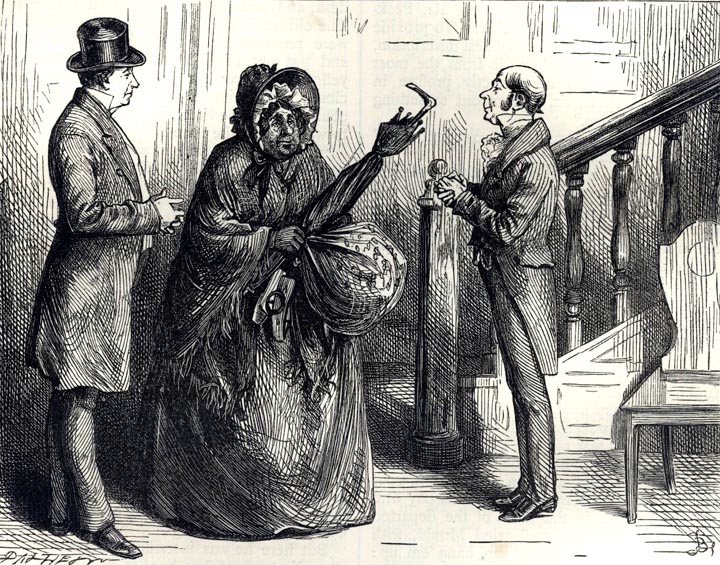 Let us start with Mrs. Gamp. Here a Dickens character has lent her own name to the English (British) language, as an umbrella all by herself. Arising out of Martin Chuzzlewit, Mrs. Gamp (Sairey Gamp to her friends) gave nursing a black eye, but she was never without her battered black umbrella. "...Mrs Gamp's umbrella, which as something of great price and rarity, was displayed with particular ostentation,...."
Subscribe to:
Posts (Atom)


